When I went through medical school, I recall learning little to nothing on topics such as disability, ableism and accessibility in health care.
Then one day, near the end of my family medicine residency, I sustained life-altering injuries and could no longer return to clinical work.
I am now a complex patient living with multiple disabilities – a moderate traumatic brain injury and incomplete spinal cord injury – and am a full-time wheelchair user. I now focus my attention on patient partnership, that is, authentically incorporating the lived patient (or caregiver, essential care partner, etc.) expertise into all aspects of health care, including medical education. I am also a disability advocate and lecturer to second-year undergraduate medical students on the topics of disability, ableism and accessibility in health care.
We know that ableism in health care leads to decreased access, poor experiences and worse clinical outcomes for people with disabilities (PWD), thus leading to significant health inequities. Unfortunately, medical education is steeped with ableism, and current medical students report that their disability education is inadequate.
It’s been suggested that to counter-act decades of ableism and inadequate disability teaching in medical education, teaching should take a disability consciousness approach, raising awareness of the historical injustices experienced by the disability community, and promoting respect, beneficence and justice that PWDs deserve.
But who teaches the medical learners matters, and this disability consciousness approach aims to situate PWDs as the teachers. This approach not only recognizes PWDs as experts of their own disabilities and experts in health care beyond their disability, it simultaneously increases learner exposure to PWDs, leading to a more holistic understanding of disability, while also dismantling some of the inherent unconscious bias, stereotyping and poor attitudes in health care.
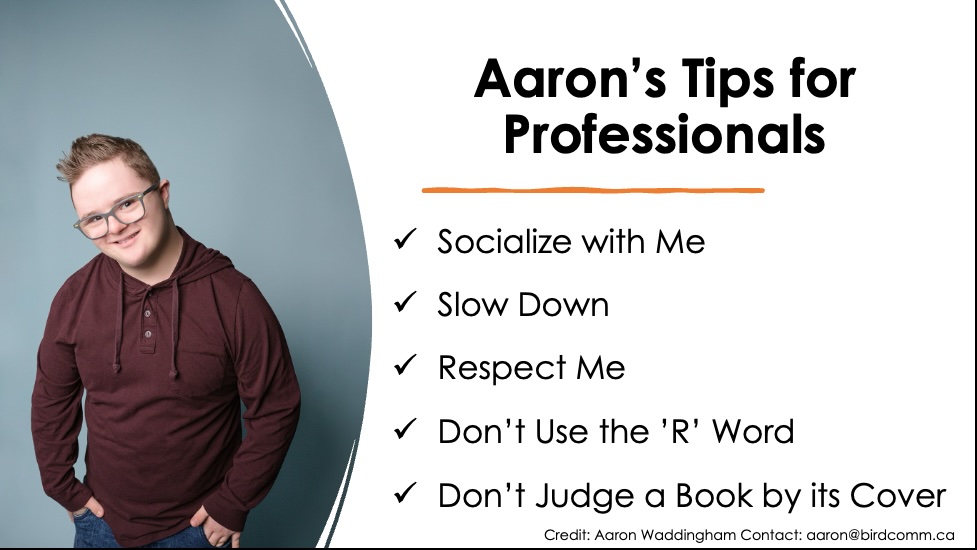
When I approach my lectures, I try to include as many PWDs as possible, including people with varying disabilities. While this approach works, some voices in the disabled community can be left behind if not intentionally included and sought out. An example of this are people with intellectual disabilities. This happens because it requires flexibility, a deviation from the standard way we teach learners. But if we do not take this approach, important voices will be left out.
For three years now, the medical students I teach have been privileged to learn from Aaron Waddingham, a young man with an intellectual disability. He was gracious enough to create a video, with assistance from his mother, about how to talk to people with Down syndrome, how doctors should speak to him and what he wants from his doctors. The creation of this video allowed Aaron to teach those in medicine in a manner that best suited him, while allowing the voice of someone with an intellectual disability to be heard. Each year that we have played Aaron’s teaching video, it is the most positively received aspect of the two-hour lecture.
As health care is paying more attention to disability education in recent years, it’s important that when including disability voices, we ensure diversity of disabled voices as well.


Thank you for this excellent article Lynn. Drawing on my experiences as a daughter of a mom living with significant physical disabilities, and as a mother of a medically complex child, I know how critically important this is. Also great to see you profiling Aaron’s brilliant advocacy work.
Thank you for all you are doing.
Warm regards,
Gail
It is so great of Dr. Ashdown to write this article, and use her own platform to advocate for the inclusion of people who have intellectual disabilities.
Full disclosure, that’s my son Aaron Waddingham…and how I wish all medical faculties took the same initiative to bring in the voices of disabled patients…and in fact, this approach would benefit all faculties – nursing, rehab medicine, social work etc. Everybody and anybody who works in health care settings is one day going to encounter a person with Down syndrome or other intellectual disability. Looking at personal biases is key (and I in fact had my own personal bias against disabled people to uncover and address when my own son was born 23 years ago). This is continuous learning for everybody.
Thank you Dr. Ashdown for writing this piece and for the ongoing work you do….