politics of health care

Making sense of Ontario’s fee codes

Most of Ontario’s doctors bill the Ontario Health Insurance Plan for their services on a “fee for service” basis. The amount doctors are paid for each service is established through negotiations between the Ontario Ministry of Health and Long-Term Care and the Ontario Medical Association. Although fees are reviewed every few years, there is disagreement about

Need & access to bariatric surgery in Ontario

The frequency of obesity has skyrocketed across Canada, and its treatment is a major challenge to the health care system.  Bariatric surgery is an effective treatment for obesity that appears to be good value for money.  Although Ontario is expanding bariatric surgery capacity, some are concerned that capacity remains below current needs.  What is bariatric

Why don’t more doctors do house calls?

Over the last fifty years, doctors have been making fewer and fewer house calls. There is little doubt that patients value physician house calls, particularly from a doctor with whom they have an ongoing relationship.  Lack of appropriate training and mentors, financial disincentives, and the changing culture of family medicine are all barriers to increasing

Public and private payment for health care in Canada

It is inaccurate to say that Canada has an entirely publicly funded health care system.  While often described as a publicly-funded system, only about 70% of health care costs are paid for publicly, with the remaining 30% paid for privately.  In Ontario, medically necessary hospital and physician costs are entirely covered by the public health care system.

National pharmacare: who are the winners and losers?

The Canada Health Act includes public coverage of services provided in hospitals and by doctors, but not prescription medications taken outside of hospital. Most provincial drug plans do provide some public coverage, but many Canadians lack drug coverage. In the last 25 years, prescription medications have become both more important and more expensive. Bringing prescription

LHINs and the governance of Ontario’s health care system

In many provinces across Canada the authority and governance of health care has been moved to regional authorities, based on the belief that local authorities can better integrate and coordinate services, and contain costs. Ontario created 14 Local Health Integration Networks (LHINs) in 2006, with the mandate to plan, fund and integrate health care services

Complementary & alternative medicine in practice and policy

Complementary and alternative medicine is a billion dollar business in Canada.  Complementary and alternative medicine is rooted in different philosophies and standards of evidence than mainstream medicine.  Many patients use both systems of medicine.  Complementary and alternative medicine is defined as any medical system, product or practice that is not thought of as a standard

The role of nurses in Ontario’s colon cancer screening program

Colon cancer screening is more effective than breast cancer screening, but uptake in Ontario is still low. Screening more individuals each year would prevent many needless deaths. Nurses can safely and effectively screen patients for colon cancer. Despite this, efforts to increase the number of screening procedures performed by nurses in Ontario are not widespread. 

Will the aging population bankrupt our health care system?

Many politicians, doctors and the public believe that aging of the population is the main cause of increased health care costs. If this is true, this paints an exceptionally worrying picture about the sustainability of health care in the future. However, somewhat surprisingly, the majority of researchers don’t believe that aging plays a major role

Federal health spending without accountability

The 2004 Health Accord agreed to a total transfer of $41 billion of federal money to the provinces and territories for health care over a ten year period. This transfer ends in 2014 when the accord expires. The legacy of the Health Accord is mixed. There have been improvements in wait times for some operations

What is the federal government’s role in health care?

Polls suggest that health care is the most important issue to Canadians in the upcoming federal election.  However, in Canada, health care delivery is largely the responsibility of the provinces and territories.  The 2004 Health Accord invested $41 billion of federal dollars in health. What were the outcomes of this federal investment in health? History

Should patients have better access to their medical records?

Should Patients Have Better Access to Their Medical Records?

Patients are increasingly interested in reading the information in their own medical records. Canadian laws and existing technologies support this in principle. However, most patients are not yet easily able to access their medical records in practice. Canadians today have easy access to a range of systems that store their personal information. The difference between

Why are so many Canadians going abroad to study medicine?

Canadian doctors studying abroad

Over the past five years, the number of Canadians studying medicine abroad has more than doubled. Almost all of these medical students want to practice in Canada. Is it good for Canada to rely on foreign medical schools to train our future doctors? David Li, a family doctor in Oshawa, is one of Ross University’s

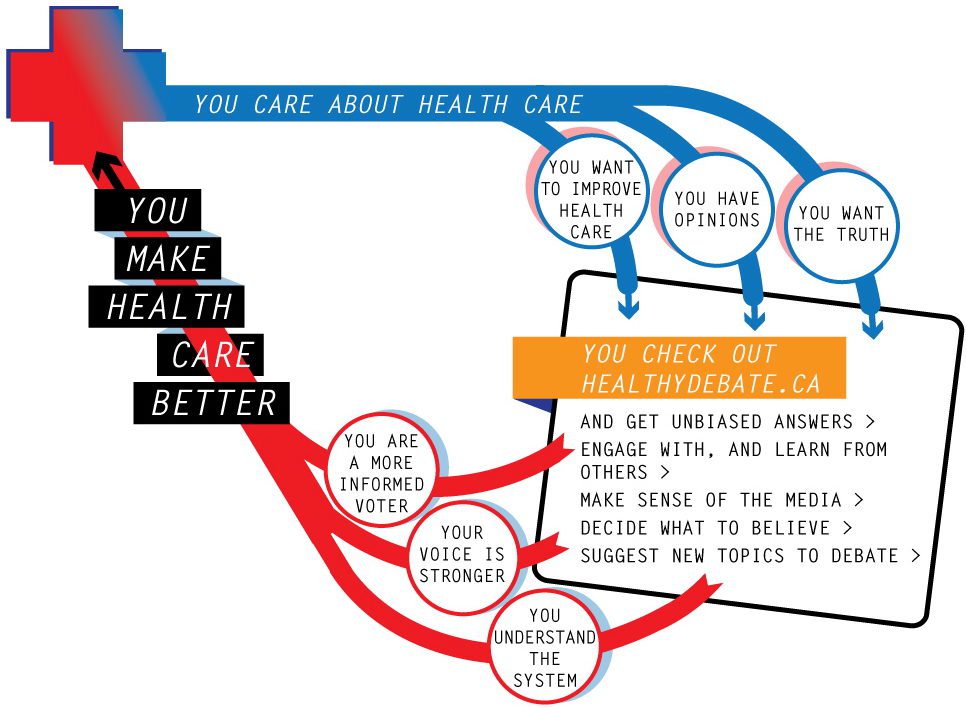
What is Healthy Debate?

Healthy Debate

Our health and the health of our loved ones is more important to us than almost anything else. We all have stories about how our health care system has provided excellent care, and how it has let us down. Despite the personal and societal importance of health care, it is our belief that many Canadians

Citizens participate in hospital restructuring processes

Citizens Participate in Hospital Restructuring Processes

Northumberland Hills Hospital in Cobourg, Ontario was facing a significant deficit. The hospital convened a citizens’ panel to advise the board about which services could be removed from the hospital. The experiment was successful – should it be used by other hospitals? Healthydebate.ca took to the street in December 2010 to gather some opinions about

Focus on quality for Ontario’s pathologists

Focus on Quality for Ontario's Pathologists

Important medical errors in Ontario have occurred in surgical pathology. A report commissioned by the Ontario government recommended an overhaul to the quality management system of surgical pathology. The recommendations for surgical pathology might have implications for other aspects of medicine. Because of public concern about reports of errors in surgery and pathology, the Ontario

Do lessons from the fight against smoking apply to reducing obesity?

A multi-pronged strategy was needed to significantly reduce smoking rates across Ontario over the last few decades. Obesity is a current and worsening public health threat.  The obesity epidemic may also need to be attacked from many angles, but may be harder to effectively fight than smoking. Healthydebate.ca took to the street in December 2010